Unlock Freshness: DIY Natural Deodorant Recipe - Effective, Odor-Fighting & Baking Soda-Free - With a Luxurious Feel
This post contains affiliate links to the products that I use myself or can recommend. If you buy products through these links,
the price will be the same for you, and I will receive a small commission, which helps to support this blog.

How to Make a Natural Deodorant
Without Baking Soda
This natural deodorant without baking soda absorbs moisture, controls odour, and is gentle on sensitive skin.
It is made with arrowroot, magnesium, clay and squalane, and contains neither aluminium nor baking soda.
In short, a good baking-soda-free deodorant should be able to:
absorb excess moisture
inhibit odour-causing bacteria
feel light and comfortable on the skin
This recipe creates a creamy, silky deodorant with a true luxury feel, suitable for daily use.
Contents:
Why I Make My Own Deodorant
Armpits - especially when freshly shaven - are open channels for harmful substances to reach the lymphatic system and bloodstream, that’s my reason to use as natural and clean ingredients as possible.
Deodorant Ingredients – A New and Improved Recipe
I have spent a long time developing a better deodorant recipe. My goal was to create a deodorant that feels exceptionally light and luxurious – something that is difficult to achieve using standard ingredients such as coconut oil, beeswax and shea butter alone.
The deodorant still needed to be natural, aluminium-free and baking-soda-free. It had to be effective, smell pleasant and feel velvety on the skin.
In all modesty, I feel this updated recipe truly hits the mark.
What Makes a Good Deodorant
For a homemade natural deodorant to be effective, it needs to do three things:
Absorb moisture
Control odor
Use scents to cover any residual odor
Those are the basics, but beyond that, I also wanted it to feel luxurious when I applied it.So here's a rundown of the ingredients I've chosen, plus a few alternatives. This information should equip you to make your homemade deodorant.
Texture is Key
I'm not a fan of sticky pastes, powders, or armpit sprays. I want a stable, creamy consistency thick enough to apply at any temperature and thin enough to leave no residue. Plus, I wanted it to feel luxurious.
I achieved the silky feel with cetyl alcohol, arrowroot powder, and beeswac Together, these ingredients thicken the formulation while providing moisture balance and a smooth, silky feel.
Thickening Agents: Lanette Wax, Beeswax and Candelilla Wax
Cetyl Alcohol is a mixture of fatty alcohols based on saturated fatty acids from coconut and palm kernel oil.
It works like a traditional wax to provide a thickening effect to the other ingredients but is far less "sticky" and provides a smoother, lighter product with the added bonus of a moisturizing effect.
Beeswax provides a natural, protective structure and helps stabilise the deodorant so it holds its shape at normal room temperatures. Unlike harder plant waxes, beeswax has a more flexible structure which – when used in moderation and balanced with lightweight oils and powders – creates a creamy, smooth texture without feeling heavy or balm-like.
Previously, I avoided beeswax in deodorants, as too high a concentration can make the product feel thick and greasy. In this formulation, however, the beeswax is carefully balanced to support structure without compromising lightness or a dry skin feel.
Beeswax is a natural by-product of honey production and has been used in skincare for centuries due to its protective and skin-friendly properties.
For those who prefer a vegan option, beeswax can be replaced with candelilla wax. Candelilla wax has a higher melting point and produces a firmer, more temperature-stable deodorant. When used in smaller amounts, it can also contribute to a smooth, lightweight texture. Because candelilla wax is significantly harder than beeswax, it requires a lower dosage and careful balancing to avoid a dry or brittle feel.
Candelilla wax is derived from the leaves of the candelilla shrub, which grows in Mexico.
Powders and Clays for Sweat Control
In most conventional deodorants, aluminum is the sweat-inhibiting ingredient, but with the side effect that it also blocks the pores. It’s not unproblematic to have too high an aluminum content in the body; that's why I try to avoid it whenever possible.
For more - read my blog: 10 Steps To Balance Your Hormones Naturally
Instead I use a mild combination of clays and plant based powders to absorb any excess moisture from naturally sweating, that doesn’t interfere with the skin’s natural function.
Arrowroot – For Silkiness and Gentle Moisture Absorption
In this recipe is arrowroot one of the key ingredients because it’s a natural, organic starch derived from the arrowroot plant and has traditionally been used in both cooking and skincare.
Arrowroot contributes to the deodorant by:
creating a silky, smooth texture
absorbing excess moisture from the underarms
leaving the skin soft and comfortable
being gentle and suitable for sensitive skin
It’s arrowroot that gives this deodorant its light, luxurious and non-chalky feel
Tapioca – Supporting Dryness and a Beautiful Finish
Tapioca contributes with:
additional dryness
a lightly mattifying effect
a stable, refined finish
Together, arrowroot and tapioca absorb moisture in a balanced way without drying out the skin.
Other Moisture-Absorbing Ingredients
To help prevent sweat marks on clothing, the following dry ingredients are particularly effective:
Kaolin Clay: Kaolin is a very mild clay that absorbs moisture without stripping the skin of its natural oils, making it ideal for daily use and sensitive skin.
Bentonite Clay: Bentonite can be used if stronger moisture absorption is desired, but in this deodorant I have chosen kaolin for its gentler, more skin-friendly nature.
Diatomaceous Earth (Silica) – For Extra Performance: Food-grade diatomaceous earth, also known as silica, is a naturally occurring mineral. In this deodorant, it helps to:
absorb excess moisture
improve texture and application
soothe sensitive skin
Here, silica is used purely for its physical properties and skin comfort benefits.
The Benefits of Oils in a Deodorant

Carrier oils play an important role in any good natural deodorant, as they help transport the other ingredients onto the skin rather than leaving a dry powder behind.
Many homemade deodorant recipes use large amounts of heavy oils, which can feel greasy or stain clothing. In this updated formulation, I have chosen a lighter approach by using squalane.
Squalane is derived from olives and is a natural component of the skin’s own lipid barrier. It feels lightweight, non-greasy and helps protect and soften the skin.
Tip: Broccoli seed oil is also a wonderful option. It has a silky, silicone-like feel and leaves the skin beautifully soft.
What Controls the Armpit Odor in the Deodorant
Most of our armpit smell comes from sweat.
We have two types of sweat.
The skin on the entire body produces a clear and odorless sweat that regulates body temperature.
The glands in the armpits and groins produce a little thicker type of sweat. The latter has no real purpose in modern times.
Sweat is usually odorless, but when mixed with the bacteria on the skin's surface, it produces odorous substances. Those who suffer from strong body odor are often born with larger and more active sweat glands in the armpits and groins.
If you want to control armpit odor, it's the bacteria you need to combat.
Previously I used baking soda (sodium bicarbonate) as my smell weapon.
However, baking soda is not without problems. The skin is a naturally acidic organ with a pH of 4.5 to 5.5. This keeps the skin protected and moisturized with healthy. Baking soda has a pH level of 9. Applying a strong alkaline base to the skin can strip it of all its natural oils and cause irritations such as itching, dry skin, redness, and sensitivity to natural elements like the sun.
Castor Oil and Magnesium as Odour Fighters
In place of baking soda, this recipe uses magnesium hydroxide and castor oil.
Magnesium hydroxide. You may have noticed magnesium hydroxide on the ingredients list in some natural deodorants on the market and in some DIY recipes. It’s not absorbed into the skin but helps neutralise odour-causing bacteria on the skin’s surface without affecting deeper skin layers where sweat glands and hair follicles are located.
Castor oil also plays an important role due to its antibacterial properties, helping to reduce unpleasant odours.Magnesium and Castor oil as odor-fighters
Extending Shelf Life
Although natural deodorants are water-free and do not require preservatives, adding an antioxidant such as vitamin E helps extend shelf life. Vitamin E protects oils and essential oils from oxidation and rancidity over time.
Recipe: Creamy Luxury Deodorant
Yields about 200 ml (4 jars of 50 ml each)
Equipment
Small bowl or heat-resistant jug with a pouring spout
4 x 50 ml aluminum or glass jars

Ingredients
40 g magnesium hydroxide
26 g arrowroot powder
10 g tapioca starch
10 g kaolin clay
8 g diatomaceous earth (silica)
72 g squalane
12 g castor oil
12 g shea butter
5 g beeswax
4 g cetyl alcohol (lanette wax)
1 drop vitamin E oil (optional)
60-75 drops of essential oils (optional). My favorite blend is 19 drops of peppermint oil, 31 drops of sweet orange oil, and 25 drops of grapefruit oil
Use fewer drops for sensitive skin or daily use.
Variations
Replace magnesium with 24 g kaolin + 16 g arrowroot
Replace squalane with MCT oil or broccoli seed oil
Replace silica with arrowroot for a milder version
Replace beeswax with approximately half the amount of candelilla wax
How to Make It (Cream Deodorant)
Mix all the powdered ingredients thoroughly in a bowl or a heatproof jug with a pouring spout.
Slowly melt the beeswax in a small saucepan over low–medium heat until fully liquid. Keep it melted for about 1 minute.
Add the shea butter to the melted beeswax and let it melt through.
Add the castor oil, squalane and (if using) vitamin E. Stir gently until completely uniform.
Remove from the heat and let the mixture cool slightly (to around 45–50°C).
Pour the oil mixture over the powders and immediately blend with a stick blender until perfectly smooth.
Add the essential oils and blend briefly to combine.
Decant into 50 ml aluminium tins or glass jars.
Leave uncovered to cool and set overnight at room temperature.
Put the lids on. If you’d like a firmer texture, pop them in the fridge for a couple of hours.
Store the finished deodorant at room temperature.
Important: melt the beeswax first, and melt it properly
Beeswax has a crystalline structure. If it isn’t fully melted, it can lead to:
a slightly grainy/crumbly texture
an uneven consistency
less slip on the skin
Fully melting the beeswax before adding the other fats “resets” the crystals and gives a smoother end result.
Pro tip 1
Stir the arrowroot into the oil phase first, before adding the rest of the powders. This “coats” the particles and makes the texture noticeably silkier.
Pro tip 2
For a truly high-end, luxury feel:
sift all powders
keep stirring as the mixture cools (this helps create a more uniform, silky texture)
How to use
Take a small amount on your fingertip and massage into the armpit until it’s no longer visible.
Alternative Recipe: Deodorant Stick (50 ml)
If you prefer a stick rather than a cream, simply increase the waxes (and, if needed, the shea butter) so it stays solid at room temperature but still melts easily against the skin.
Ingredients
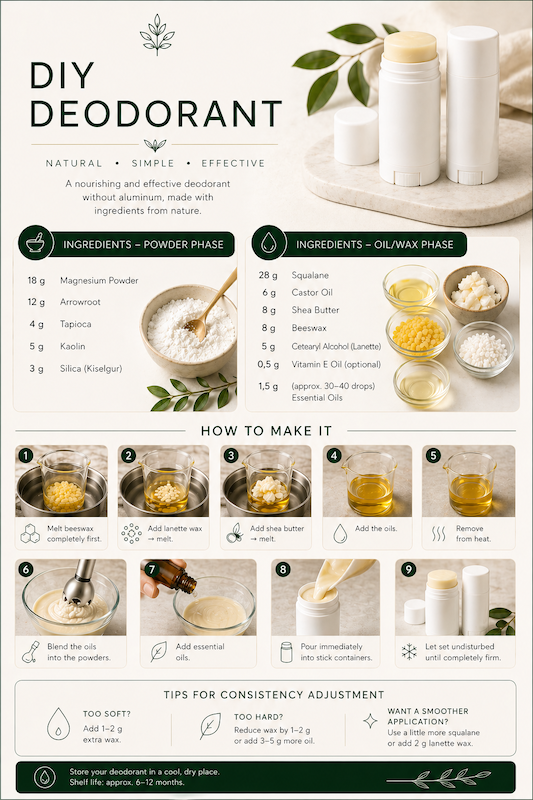
Powder phase:
18 g magnesium hydroxide
12 g arrowroot
4 g tapioca starch
5 g kaolin clay
3 g silica (diatomaceous earth)
Oil/wax phase:
28 g squalane
6 g castor oil
8 g shea butter
8 g beeswax
5 g cetearyl alcohol (Lanette)
0.5 g vitamin E (optional)
1.5 g essential oils (approx. 30–40 drops)
How to Make the Stick Deodorant
Melt the beeswax fully first.
Add the cetearyl alcohol and melt.
Add the shea butter and melt.
Stir in the oils.
Remove from the heat.
Blend the oil phase into the powders until smooth.
Add the essential oils and mix well.
Pour immediately into stick containers.
Leave to set undisturbed.
Texture tweaks
Too soft? Add 1–2 g extra wax.
Too hard? Reduce wax by 1–2 g, or add 3–5 g more oil.
Want more glide? Use a little more squalane or add 2 g more cetearyl alcohol.
FAQ – Natural Deodorant Without Baking Soda
-
Yes. A baking-soda-free deodorant can be just as effective. Instead of baking soda, it uses ingredients such as magnesium, clay and plant-based powders to absorb moisture and help inhibit odour-causing bacteria—without irritating the skin.
-
Often, yes. Baking soda has a high pH, which can disrupt the skin’s natural balance. A baking-soda-free formula is typically gentler and better suited to sensitive skin or freshly shaved underarms.
-
It doesn’t block the sweat glands. Instead, it absorbs excess moisture and reduces bacteria on the skin’s surface—where odour actually comes from.
-
Deodorant targets odour. Antiperspirant reduces sweating by blocking the pores. Natural deodorants work with the body’s normal function rather than trying to stop it.
-
Yes. It’s designed for daily use and contains no aluminium or baking soda. If your skin is very sensitive, start with a small amount and increase gradually.
-
Yes. Magnesium can be replaced with a blend of kaolin and arrowroot. A good starting point is 60% kaolin and 40% arrowroot for gentle, effective moisture absorption.
-
Arrowroot absorbs moisture, creates a silky texture and makes the deodorant more pleasant to apply. It’s a mild starch that tends to work well for sensitive skin.


