The Big Health Benefit of Drinking Apple Cider Vinegar Before Bed That No One Really Talks About
This article contains affiliate links to products that I use myself or can recommend.
You can read about my affiliate policy here.

Apple Cider Vinegar Before Bed – A Small Trick With Big Health Benefits
The older we get (let’s not point fingers here, but yes 👉🏻 me), the harder it becomes not to accumulate belly fat. And it’s incredibly frustrating, especially when you already live a healthy and active lifestyle.
That’s why I’ve been looking for solutions – and I’ve found a surprisingly effective quick fix. It’s not only a powerful way to combat belly fat, but it also comes with a whole range of other health benefits.
It’s as simple as this: a small glass of water with one tablespoon of apple cider vinegar before bed does much more than you’d expect.
Recent research and nutritional science point to the acetic acid in apple cider vinegar having fascinating effects on blood pressure, fat metabolism, gut health, and even the nervous system.
Here’s my full breakdown of why it works – and how it benefits your body all the way down to the cellular level.
Contents
Acetic Acid – The Engine of Energy Production
How Your Body Boosts Fat Burning at Night
Apple Cider Vinegar Strengthens Gut Mitochondria and Barrier
Oxygen Balance – The Key to a Healthy Microbiome
The Vagus Nerve and Deeper Sleep
How to Take It
Summary – The Benefits of Apple Cider Vinegar Before Bed
My Preferred Apple Cider Vinegar
Acetic Acid – The Engine of Energy Production
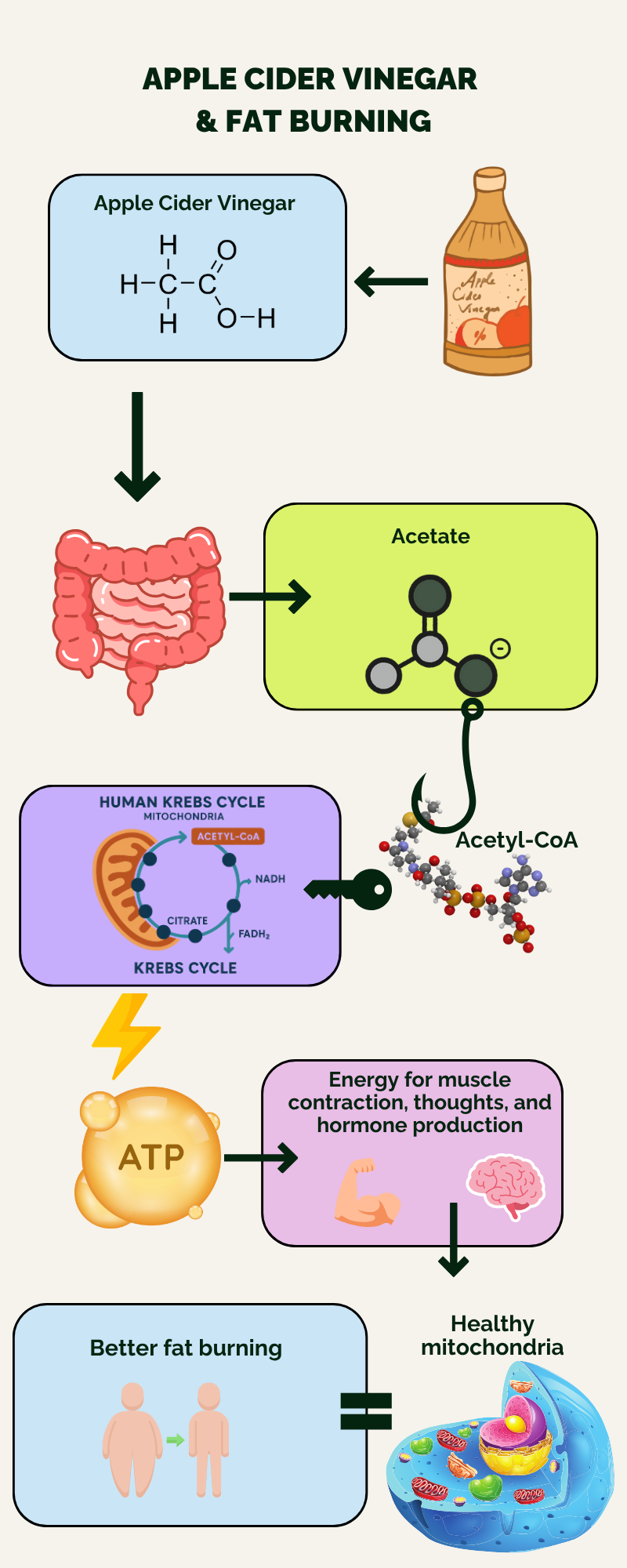
Acetic acid, the main component in apple cider vinegar, is a postbiotic – a health-promoting compound produced by microorganisms during fermentation (in this case, when apples are turned into vinegar). It’s also a short-chain fatty acid (SCFA) that the body can absorb and use quickly without heavy digestion.
When you drink apple cider vinegar, here’s what happens in your body:
Acetic acid → acetate
In digestion, acetic acid is converted to acetate – a form of energy molecule your body can easily use.
Acetate → acetyl-CoA
Acetate binds to a helper molecule called Coenzyme A, forming acetyl-CoA – the “key” that unlocks your body’s main energy production system: the Krebs cycle (also called the citric acid cycle).
Krebs cycle = the energy engine
Inside your cells’ power plants, the mitochondria, the Krebs cycle runs in a continuous loop. Acetyl-CoA fuels the process, releasing electrons that pass through the electron transport chain. This creates ATP, your body’s main energy currency, which powers everything from muscle contraction to thought processes and hormone production.
Healthy mitochondria = better fat burning
When mitochondria are strong and efficient, they can more easily switch to burning fatty acids for fuel – especially when insulin is low, such as at night. That means your body doesn’t just “coast” while you sleep – it can burn fat efficiently and produce clean energy all night long.
How Your Body Boosts Fat Burning at Night
AMPK – your body’s “energy thermostat”
AMPK (AMP-activated protein kinase) is an enzyme that acts like your cells’ fuel gauge. When energy runs low and your cells need more fuel, AMPK triggers processes that increase fat burning and improve your ability to generate energy.
Acetic acid in apple cider vinegar stimulates AMPK, turning up fat oxidation in the mitochondria – not just the fat under your skin, but also deep visceral fat around your organs, which is much harder to get rid of.
Autophagy – the cell’s cleaning service
Acetic acid is also linked to increased autophagy, the process where cells break down and recycle old or damaged components – like taking apart a machine, cleaning the parts, and putting it back together so it runs better.
Autophagy clears out waste, damaged proteins, and defective mitochondria, freeing up resources for new, healthy cell structures.
The result:
Easier shift to fat as fuel
More efficient mitochondria
Cleaner, more stable energy metabolism
Reduced risk of energy crashes and inflammation
Apple Cider Vinegar Strengthens Gut Mitochondria and Barrier
Your gut lining cells are among the most energy-hungry cells in your body, packed with mitochondria that work constantly to keep your gut functioning well.
When these mitochondria get stronger:
Tighter “tight junctions”
The connections between gut cells stay sealed, reducing the risk of “leaky gut” – where bacteria and toxins (like LPS endotoxins) leak into the bloodstream and cause inflammation.
Less systemic inflammation
A strong gut barrier means fewer harmful substances enter the body, calming the immune system and reducing chronic inflammation linked to joint pain, skin issues, fatigue, heart disease, and metabolic disorders.
Higher stress resilience
Healthy mitochondria protect gut cells from oxidative stress, making them better able to handle daily dietary shifts, toxins, and minor infections without barrier damage.
Oxygen Balance – The Key to a Healthy Microbiome
Gut mitochondria are oxygen consumers. They use oxygen for aerobic metabolism, producing ATP from fats and sugars.
When functioning well, they pull oxygen out of the gut lumen, keeping oxygen levels low – exactly what your best gut bacteria need to thrive.
Beneficial anaerobes like Akkermansia, Faecalibacterium, and Bifidobacterium flourish in low-oxygen conditions, producing SCFAs that protect the gut lining and lower inflammation.
Meanwhile, pathogens like E. coli, Klebsiella, and certain parasites struggle when oxygen is low. If mitochondria are weak and oxygen stays high, these harmful microbes can take over.
By supporting strong gut mitochondria, apple cider vinegar helps create a microbial ecosystem where the good thrive and the bad are kept in check.
The Vagus Nerve and Deeper Sleep
The tangy taste of apple cider vinegar stimulates cranial nerve 10 – the vagus nerve, one of the body’s longest nerves, running from the brain down through the heart, lungs, and digestive system.
When activated, the vagus nerve signals the body to switch to the parasympathetic “rest-and-digest” mode. Heart rate slows, breathing deepens, digestion activates – and the body shifts into repair and recovery mode.
Parasympathetic dominance is linked to deeper, more restorative sleep. Many people find they sleep more soundly and wake up refreshed when they activate the vagus nerve in the evening – something a small glass of water with apple cider vinegar can help with.
How to Take It
Mix 1 tbsp organic, unfiltered apple cider vinegar into 4–8 oz of water
Drink about 30 minutes before bed
Rinse your mouth afterward (or brush later) to protect tooth enamel
Summary – Benefits of Apple Cider Vinegar Before Bed
Stabilizes blood pressure and improves blood vessel function
Activates AMPK to burn fat – including stubborn visceral fat
Strengthens gut mitochondria and seals the gut barrier
Creates a healthy, low-oxygen gut environment for good bacteria
Reduces inflammation throughout the body
Activates the vagus nerve for calmer, deeper sleep
A single glass of water with apple cider vinegar before bed may be one of the easiest, cheapest, and most natural ways to support your health. It helps cells produce energy more efficiently, the gut to heal, sleep to deepen – and fat burning to run all night.
Try it for a couple of weeks and see – you might wake up with more energy and a flatter stomach all of a sudden.
My Preferred Apple Cider Vinegar
Whenever possible, I choose Demeter-certified products – better for both the environment and your body.
I prefer apple cider vinegar with “the mother” – meaning it’s alive and contains beneficial bacteria.
My go-to is Voelkel, a German brand combining Demeter-certified biodynamics, unfiltered and unpasteurized quality, and a fresh, full-bodied flavor. The only Demeter-certified apple cider vinegar I’m aware of in America is Dr. Mercola Solspring Biodynamic Organic Apple Cider Vinegar.
I use apple cider vinegar for baking, veggie juices, salad dressings – and, as this article shows, as a bedtime drink.
Shelf life: Unopened, 2–3 years if stored cool and dark (fridge). After opening, it keeps for at least 1–2 years thanks to its natural acidity. Over time it may develop more sediment or “mother” – perfectly natural and harmless.
-
Acetic Acid, AMPK Activation & Metabolic Effects
McCarty MF. (2013) – Found that dilute acetic acid (like vinegar) can activate AMPK in tissues, which plays a vital role in fat burning and energy regulation.
Ding Q. et al. (2025) – In animal studies, acetic acid enhanced AMPK phosphorylation and reduced liver fat, supporting the idea that acetic acid supports fat oxidation.
Autophagy
Shabkhizan R. et al. (2023) – Reviews how autophagy enables cells to recycle damaged components, promoting cellular health; a foundational process relevant to your mechanistic claims.
Gut Microbiome, Barrier Integrity, and Inflammation
Xia T. et al. (2023) – Animal study showing vinegar can alter gut microbiome composition, reduce inflammation, and enhance immune markers (e.g., Akkermansia).
Zachos et al. (2024) – Review explaining the critical interplay between mitochondria and gut microbiome in maintaining gut health and immune balance.
Human Studies: Glycemic Control & Weight Loss
Mitrou P. et al. (2015) – Demonstrated vinegar’s effect on lowering postprandial glucose in type 2 diabetes patients, suggesting improved metabolic response.
Jafarirad S. et al. (2023) – Randomized clinical trial in type 2 diabetics: daily 30 mL ACV reduced fasting glucose, HbA1c, LDL cholesterol, and improved lipid profile over 8 weeks.
Abou-Khalil R. et al. (2024) – Small human trials in Lebanon showed ACV consumption led to reductions in body weight and body fat.
General Health Benefits & Safety
Time Magazine – Highlights that acetic acid may enhance fat metabolism and reduce blood sugar spikes, although effects are modest.
Verywell Health (2025) – Notes ACV may support satiety, blood sugar control, and lipids when combined with a healthy diet; emphasizes the need for more evidence.
Healthline (2021) – Confirms ACV is low in calories (<3 kcal per tablespoon) and unlikely to break a fast or inhibit autophagy.
Simple.life (2024) – Reiterates that small amounts of ACV don’t disrupt fasting or autophagy.
Examine.com FAQ (2025) – Clarifies that vinegar does not increase metabolic rate but may aid fat loss in conjunction with diet.



Glow from the Inside Out: The Ultimate Guide to Red and Infrared Light Therapy
Ready to boost your health with the power of light? Discover how red and infrared light can transform your skin, supercharge muscle recovery, sharpen your focus, and improve your sleep—naturally. In this all-in-one guide, we break down how it works, how to choose the right device, dial in your dosage, and find the perfect light panel for your lifestyle. Step into the glow and feel the difference.